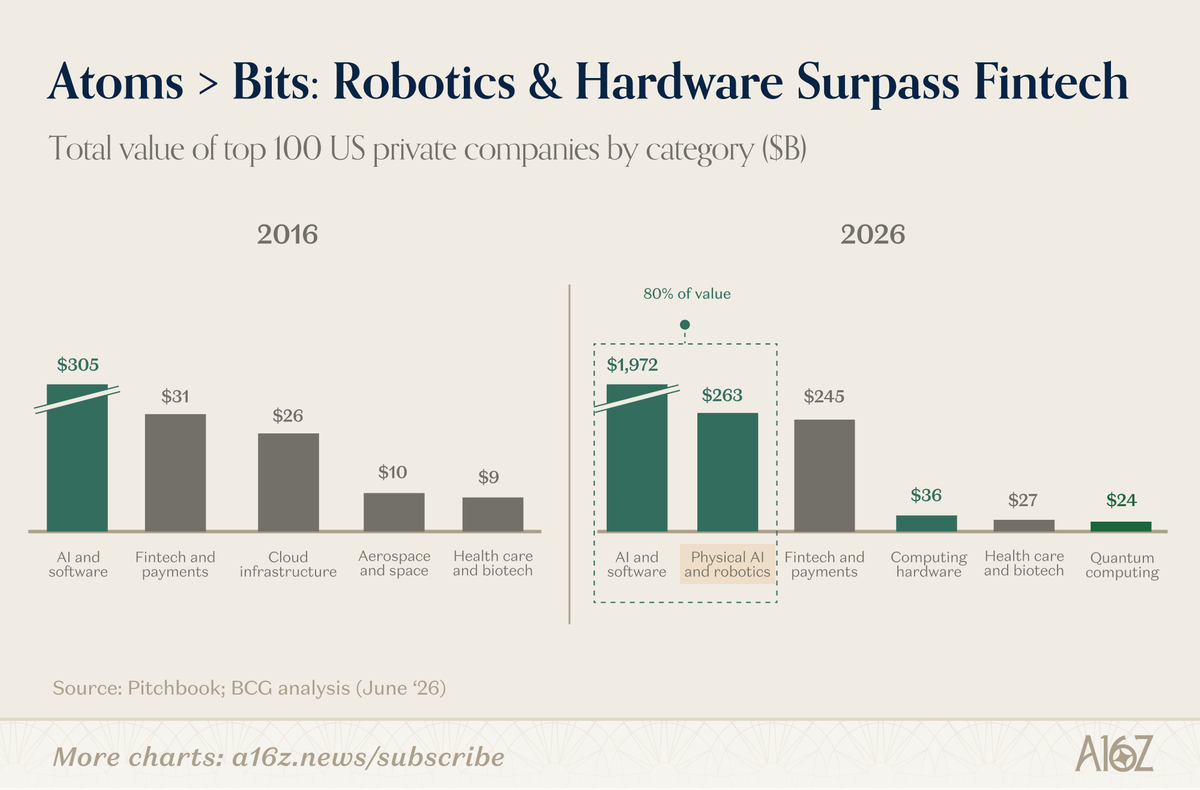
Source: Pitchbook; BCG analysis via a16z, June 2026
In 2016, physical AI and robotics did not register as a category among the top 100 most valuable private companies in the United States. Fintech sat at $31 billion, cloud infrastructure at $26 billion, and AI and software dominated at $305 billion. A decade later, physical AI and robotics has grown to $263 billion and surpassed fintech and payments ($245 billion) to become the second-largest private company category, according to Pitchbook and BCG analysis published by a16z. A category that did not exist on the chart in 2016 now has more private market value than the entire payments infrastructure that powered the last decade of venture capital.
The speed of the rotation is the more interesting story. Robotics companies have already raised $55.8 billion globally in H1 2026, according to Dealroom, a figure nearly double what the sector raised in all of 2025. Crunchbase's narrower robotics-specific dataset captures $18.8 billion over the same period, already above every prior annual record, with half the year still to go. Q1 alone was a record by both deal value and deal count, with approximately $16 billion invested across nearly 500 deals, roughly 4.5 times the value of the entire 2021 to 2025 period combined.
Why Capital Is Rotating from Bits to Atoms
a16z's American Dynamism team framed the thesis directly: software determines what a robot should do, but hardware is what executes in the physical world. For AI to move beyond screens and into manufacturing, logistics, defence, and healthcare, it needs a body, and that body requires actuators, sensors, batteries, compute chips, and structural components, each of which represents a market now attracting capital at a scale that software infrastructure commanded five years ago.
The investment thesis is playing out across three distinct layers simultaneously, per TechTimes analysis of the funding surge. The first is the model layer, where Vision-Language-Action models are turning robot brains into software platforms commanding AI infrastructure multiples. The second is the hardware layer, where humanoid and autonomous systems are being built for factory floors and logistics. The third is the deployment layer, where Robots-as-a-Service agreements are beginning to generate recurring revenue at commercial scale.
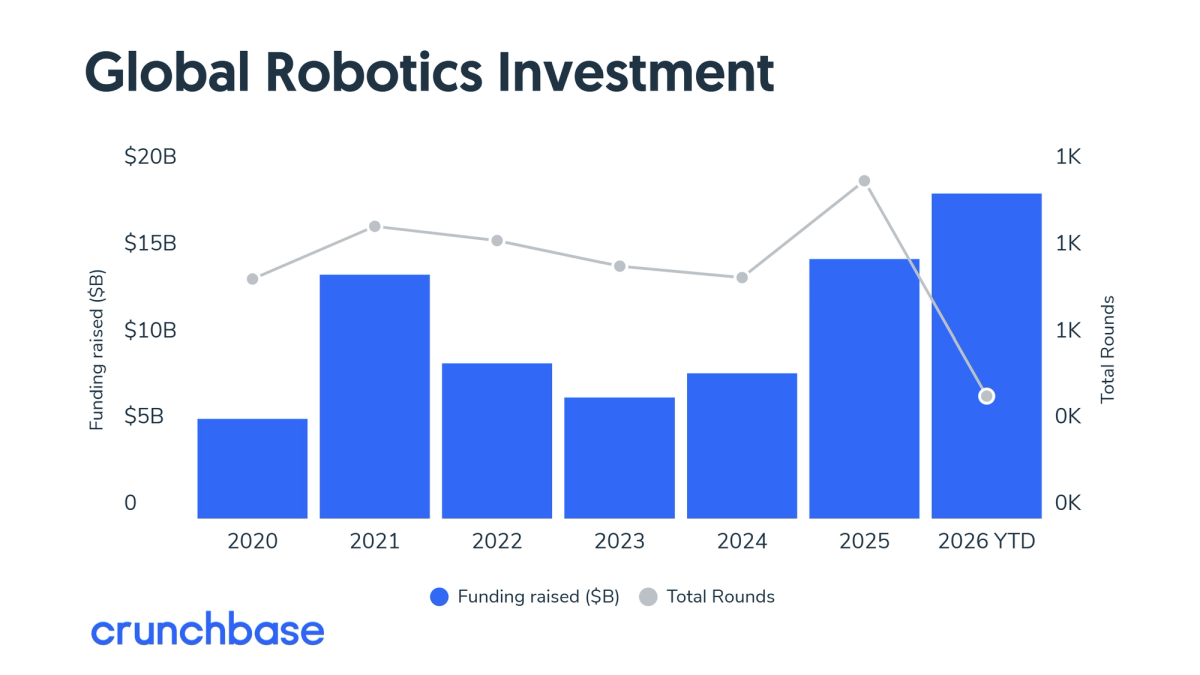
Source: Crunchbase, 2026
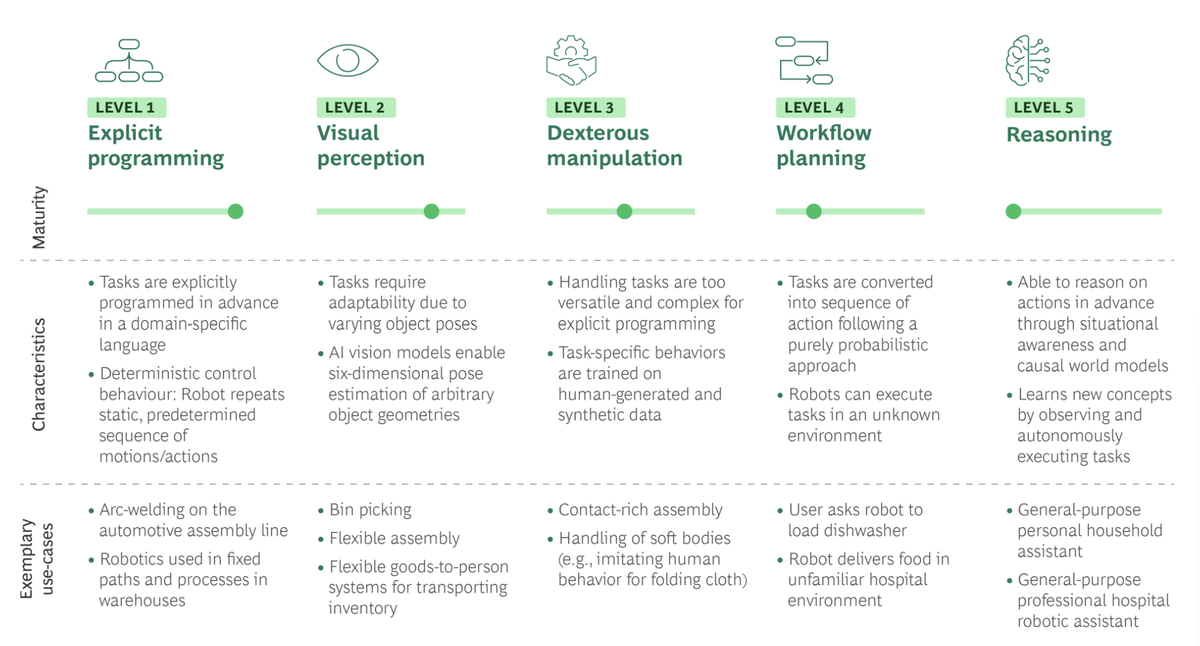
Source: BCG, 2026
The evidence of actual deployment is what separates 2026 from prior robotics cycles. Figure's Figure 02 supported over 30,000 vehicles at BMW's Spartanburg facility, handling more than 90,000 parts across 1,250 hours of real production. Agility Robotics signed a Robots-as-a-Service agreement with Toyota Motor Manufacturing Canada in February 2026, with seven commercial Digit units active in RAV4 material handling. These are early commercial contracts in factories that were already operating, not pilot programs.
Big Tech is drawing the same conclusion. Meta acquired San Diego-based Assured Robot Intelligence in May, absorbing the team into its Superintelligence Labs unit to accelerate training of its foundational physical AI model. Skild AI raised $1.4 billion, tripling its valuation to $14 billion in seven months. Neura Robotics pulled in up to $1.4 billion in a Series C backed by Amazon, Nvidia, Qualcomm, Bosch, Schaeffler, and the European Investment Bank. Saronic raised $1.75 billion at a $9.25 billion valuation for autonomous maritime defence.
The Risk the BCG Report Flags
The opportunity and the uncertainty are both worth sitting with. BCG's report on physical AI puts analyst projections for the humanoid robotics market by 2030 at anywhere between under one million annual units and more than six million. If the higher end materialises, humanoids could fundamentally redefine how manufacturing and logistics operate. If the forecasts fizzle, BCG writes, the sector risks becoming "one of the largest misallocations of industrial capital in recent years." That is quite a range, and it is worth holding onto when the funding headlines are moving this fast.
Wedbush's Dan Ives told CNBC that humanoid robots could represent one of the biggest market opportunities in the AI revolution, but noted that the core leading companies in the space are still private. SoftBank CEO Masayoshi Son told CNBC that physical AI and robotics were where he saw the next trillion-dollar company emerging from. Both are bullish. Neither is saying the outcome is certain.
What This Means for Private Market Investors
The a16z chart is a useful frame for thinking about where value is being created, but also about where it has already been created. The fintech parallel is instructive. In 2016, fintech was at $31 billion among private companies and growing fast. By the time Stripe, Klarna, and Chime reached public markets or approached listings, the multiple expansion had already happened. Physical AI is at the equivalent moment, with the additional complexity that the capital intensity required means the private window is longer and the companies reaching commercial scale are doing so with much larger balance sheets.
As we covered in our piece on Quantum Systems' $1.2 billion raise, mainstream institutional capital from Blackstone, Fidelity, Wellington, and Airbus has already moved into the autonomous systems segment. The Crunchbase record figures from H1 2026 confirm that is not a one-off transaction but part of a broader capital rotation. And as our piece on AI and energy demand covers, the infrastructure required to power physical AI at scale is itself an investable category that is still largely private.
For wholesale investors, the BCG caution is worth holding alongside the a16z data. The direction of capital is clear. The dispersion of outcomes within the category is wide. Picking the right companies, structures, and entry points inside physical AI will matter more than simply having exposure to the category.
NonPublic Pty Ltd (ABN 49 607 216 928) holds Australian Financial Services Licence #482668. Investments are available to wholesale and sophisticated investors as defined under the Corporations Act 2001. This content is general in nature and does not constitute financial product advice. It does not take into account your objectives, financial situation, or needs. Investing in private markets involves significant risk, including the potential loss of your entire investment. Past performance is not a reliable indicator of future results. You should obtain independent financial advice before making any investment decision.
The Pre-IPO & Private Investment Marketplace for Australian Wholesale Investors
Get started today to learn how NonPublic can give you access to exclusive deals.
Get Started