Venture capital in Australia and New Zealand raised more money across fewer deals in 2025, and that single pattern runs through almost every section of PitchBook's 2026 ANZ breakdown. Deal value rose while deal count fell for a fourth consecutive year, fundraising improved while the number of funds closing dropped, and in each case the capital gathered around larger companies and managers, and around assets with more predictable cash flows.
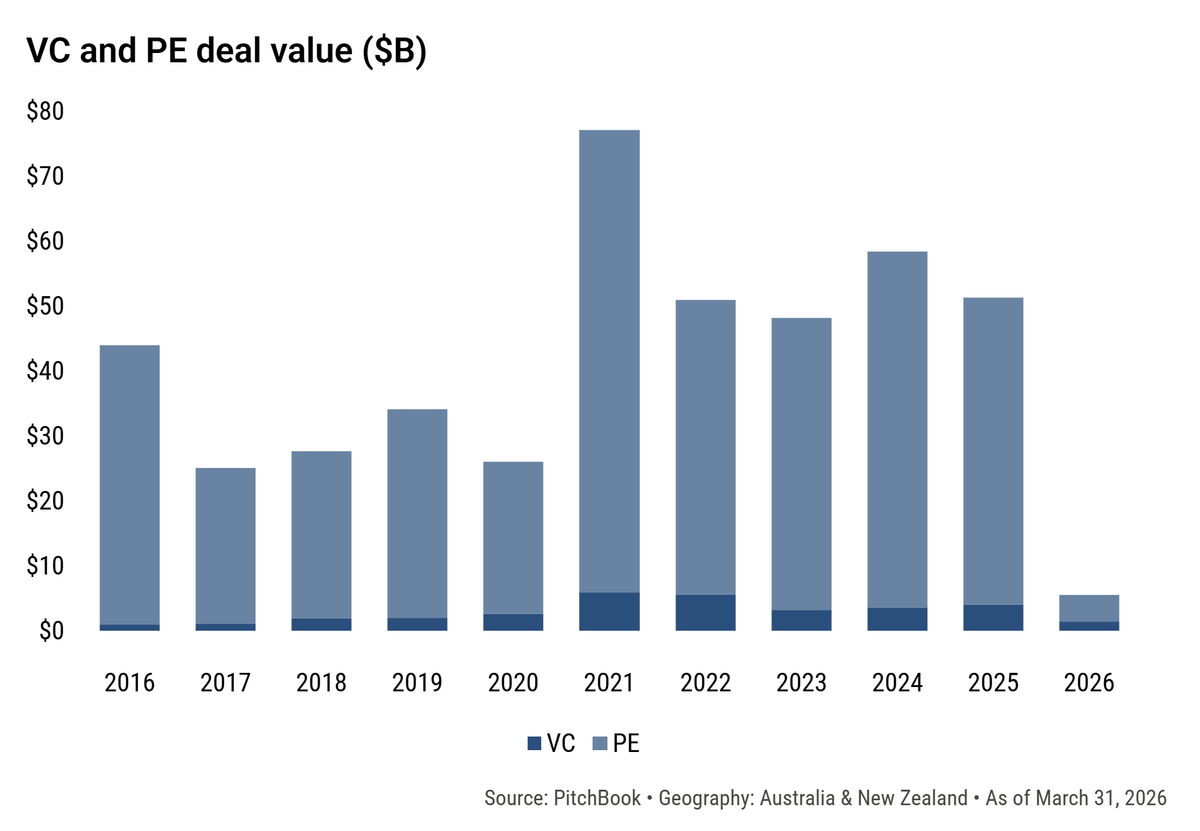
Across private equity and venture combined, the region recorded US$51.3 billion in deal value over 1,066 transactions in 2025, down from US$58.4 billion across 1,082 deals in 2024. PitchBook attributes most of that decline to the US$16 billion AirTrunk transaction that inflated the 2024 total, and notes that without it, 2025 private equity deal value came in ahead of the previous year.
Venture recovered, but around fewer companies
ANZ venture deal value rose 12.3 per cent to US$4 billion in 2025, while deal count fell from 652 to 600. PitchBook describes the gap between rising value and falling count as a continued flight to quality, with investors backing a smaller pool of larger, higher-conviction companies while the long tail of smaller rounds keeps thinning.
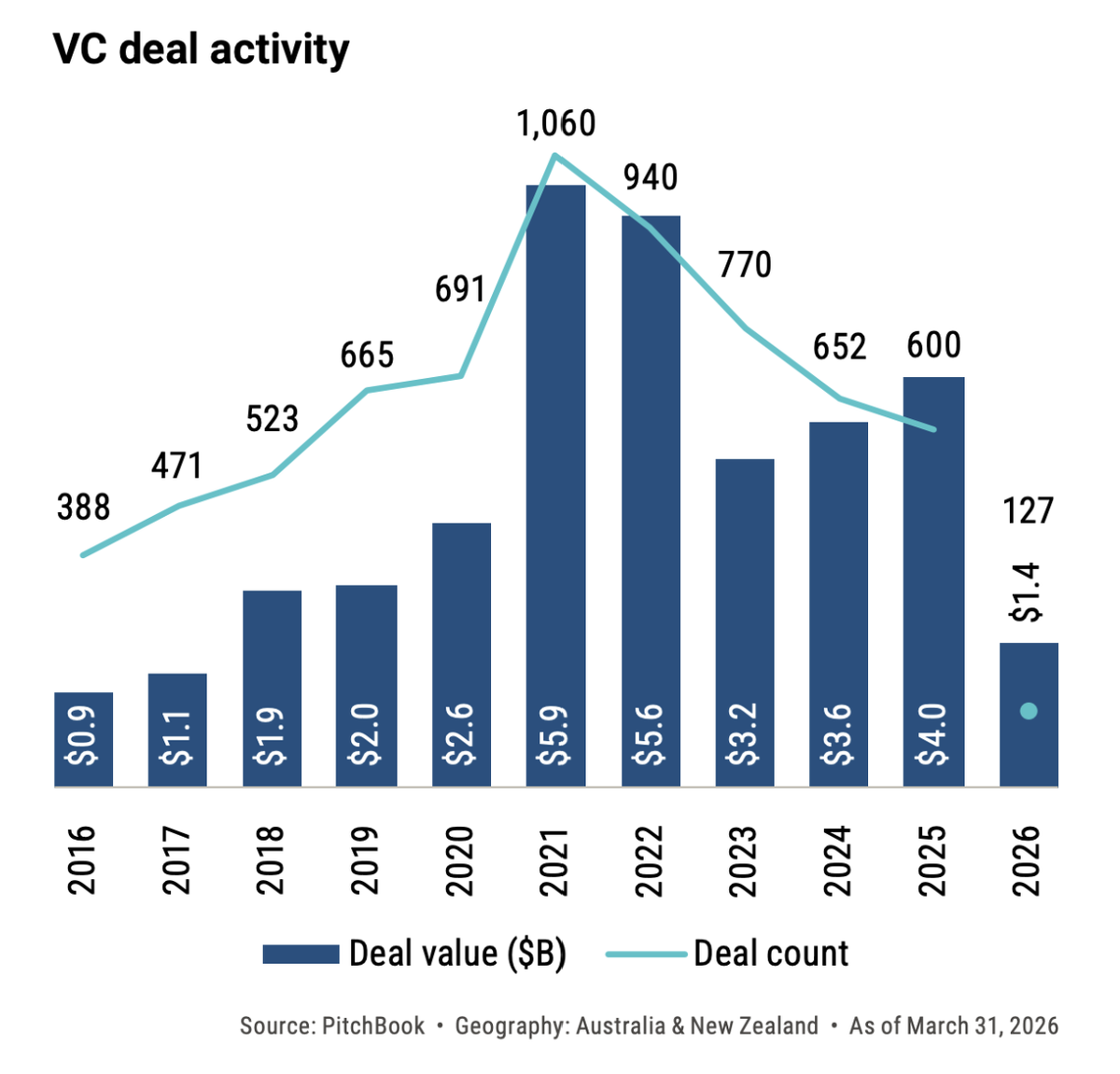
Australia accounted for almost 90 per cent of the region's venture deal value, while New Zealand recorded US$449 million across 103 deals, supported by a handful of later-stage rounds. The momentum carried into 2026, with the first quarter producing US$1.4 billion across 127 deals, the strongest first-quarter value since 2022, led by New Zealand agtech company Halter's US$220 million Series E.
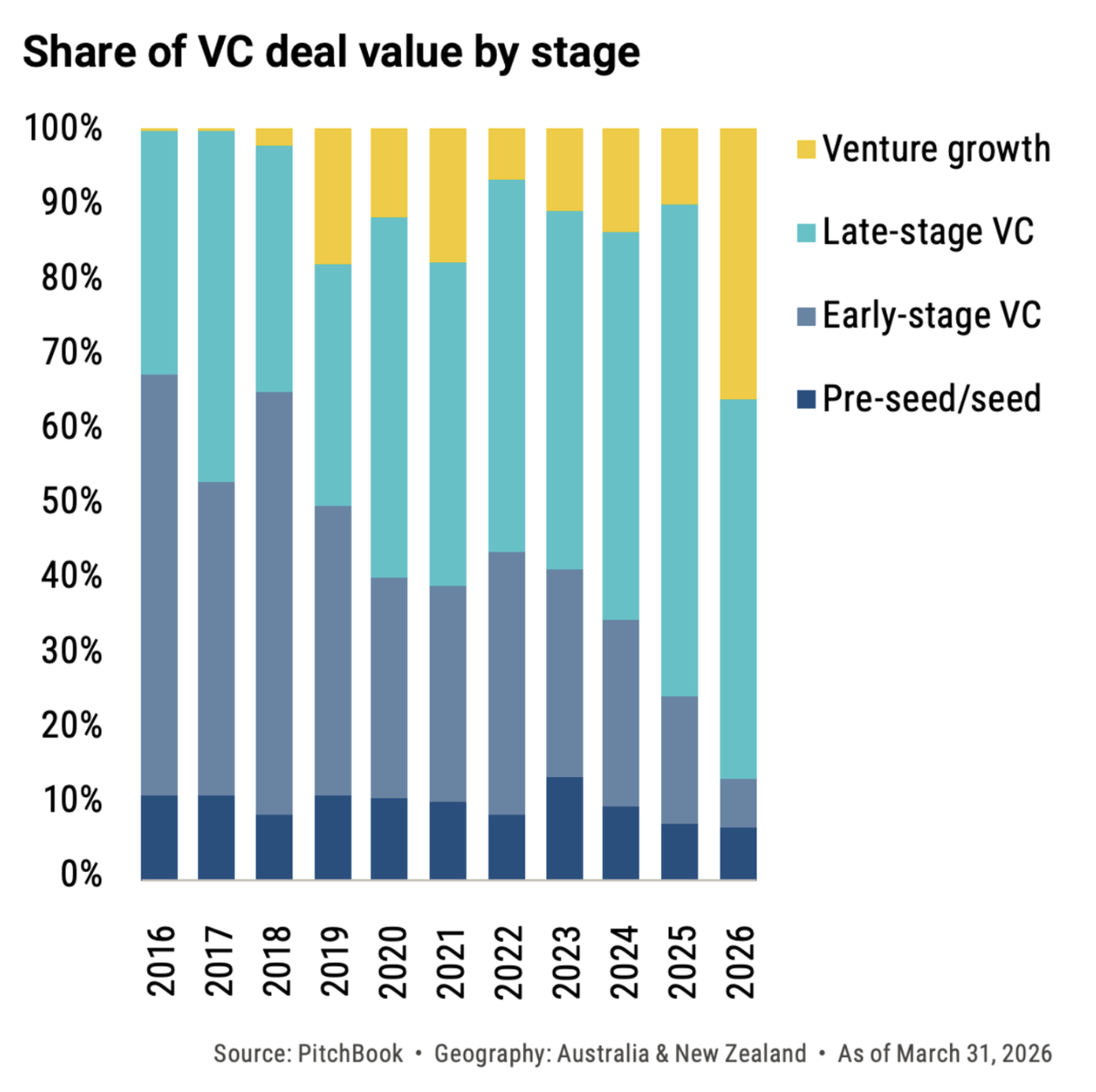
The shift toward later stages is the clearest trend in the data. Late-stage and venture growth rounds made up US$3 billion, or 75.5 per cent of total venture deal value in 2025, while pre-seed, seed and early-stage rounds contributed US$1 billion between them. The median age of companies raising venture capital has climbed from three years in 2016 to 5.7 years in 2025, and the average pre-money valuation rose to US$63.4 million from US$52 million a year earlier.
Concentration at the top reinforces the point. Firmus Technologies, which builds liquid-cooled data centre platforms for AI computing, raised US$541.1 million in the region's largest venture deal of the year, representing roughly 13 per cent of all ANZ venture deal value on its own, and the ten largest deals accounted for more than a third of the annual total. PitchBook's own framing of the year ahead is whether the recovery extends into earlier-stage company formation or stays anchored around a small group of scale companies.
Software leads, with AI running through every sector
Software remained the largest venture industry by both value and deal count, attracting US$1 billion across 230 deals, or 25.5 per cent of regional value and 38.3 per cent of deals. PitchBook points to Atlassian, Canva and Xero as reference points that have given founders and investors a visible example of globally relevant platforms built from the region.
AI activity cut across the industry mix rather than sitting in a single category. Firmus sits in the infrastructure layer of the AI build-out, while Harrison.ai, the Sydney healthtech company that raised a US$111.8 million Series C, represents the application layer with AI tools for radiology and pathology. PitchBook reads these deals as evidence that AI investment in ANZ is heading toward both the infrastructure needed to scale computing and the vertical tools that embed AI into specific industries.
Private equity told a related story through energy, which was the sector with the clearest move in 2025, rising to US$5.8 billion across 31 deals from less than US$1 billion the year before on the back of utilities, energy infrastructure and energy transition assets. Deals involving Clarus, Pioneer Energy, GreenSquareDC and ProTen point to sustained sponsor demand for assets tied to power reliability, decarbonisation, food security and digital infrastructure.
Fundraising rewarded scale and track record
Total fundraising across all asset classes reached US$17.4 billion across 34 funds in 2025, up from US$12 billion across 46 funds in 2024. The headline figure owes a great deal to Macquarie, whose three infrastructure and energy transition vehicles raised a combined US$11.1 billion, close to two-thirds of the regional total.
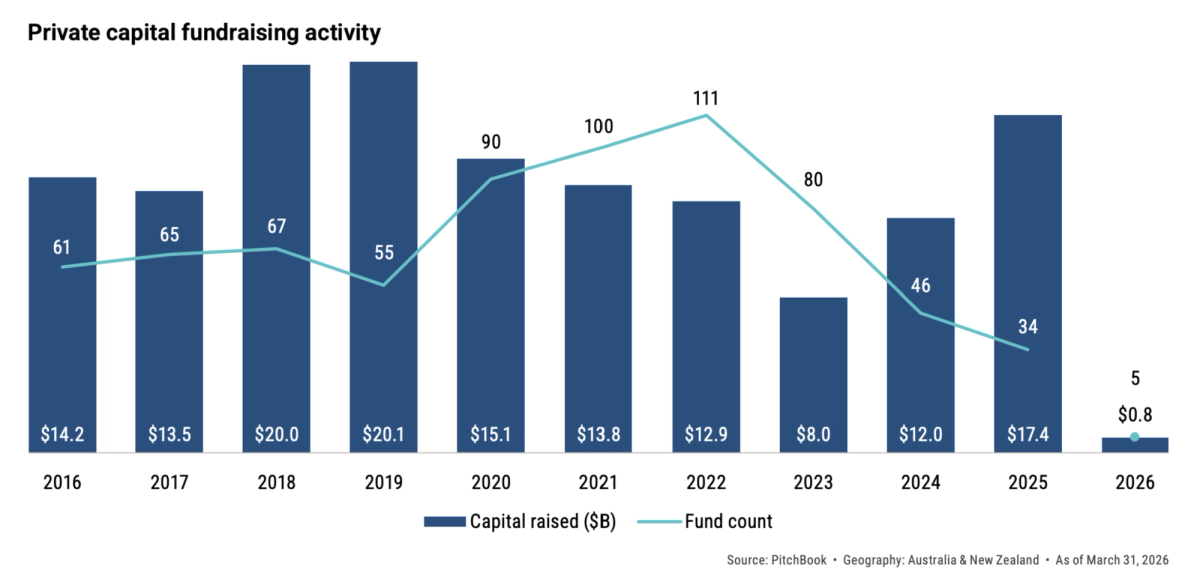
The gap between experienced and emerging managers was stark. In private equity, experienced firms raised US$2.9 billion across three funds while emerging firms raised US$0.2 billion across one. In venture, experienced managers closed on US$1 billion across three funds compared with US$0.3 billion across 12 funds for emerging peers. Venture fundraising overall recovered to US$1.3 billion from US$0.6 billion in 2024, with AirTree Ventures Core Fund V the largest venture fund to close at US$650 million, and Pacific Equity Partners Fund VII was the largest private equity fund at US$2.1 billion.
PitchBook ties the fundraising outlook to the exit cycle. Until distributions improve, limited partners have less capacity to recommit, and managers with a clearer record of returning cash to investors are likely to find raising capital easier than those without recent distributions.
Superannuation is the anchor, and it has room to grow
Australia's superannuation system reached approximately A$4.1 trillion by September 2024 and is projected to reach A$6 trillion by 2030, according to PitchBook's coverage of the sector. Super funds currently allocate around 18 per cent of assets to unlisted equity, property and infrastructure, below the 30 to 40 per cent common among large Canadian, US and Dutch pension funds, so even a modest narrowing of that gap would add meaningfully to the domestic capital available for private markets.
Offshore capital remains the other pillar. Nondomestic investors took part in 54.5 per cent of ANZ private equity deals in 2025 and accounted for 73.6 per cent of total deal value, which PitchBook attributes to the region's governance, transparent regulation, legal frameworks and currency convertibility.
Exits improved, but listings stayed quiet
Venture exit value rose to US$4.1 billion across 67 transactions in 2025, up from US$2.5 billion across 58 in 2024 and the strongest annual count since the 2021 peak. Acquisitions carried most of that activity, while the IPO market delivered only US$0.4 billion across six listings, well below the US$1.6 billion to US$1.9 billion that listings produced each year between 2019 and 2021.
Canva is the name PitchBook identifies as the most closely watched potential catalyst. The Sydney design platform was last valued at US$42 billion in an August 2025 employee share sale and has reportedly pushed a potential IPO out to 2027, and a listing at that scale would likely be the largest Australian venture-backed exit to date.
What the report means for wholesale investors
PitchBook's data describes a market that rewards scale at almost every level, from the companies raising venture rounds to the managers closing funds and the infrastructure assets drawing institutional money. For individual wholesale investors, that has two practical implications. The ANZ companies attracting the most capital are older and more expensive at the point of investment than they were a few years ago, and the early-stage end of the local market, where individual investors have traditionally found their way in, is the part that has thinned most.
Much of the AI opportunity, meanwhile, sits in US-domiciled private companies, OpenAI and Perplexity among them, which raise almost entirely from US and international investors. Reaching them requires structures that can connect Australian wholesale investors to US private markets, and those structures carry their own liquidity constraints and wider private market risks that deserve careful assessment before committing capital. NonPublic's pre-IPO guide explains how those structures work.
Look at the opportunities currently available on NonPublic.
All figures are in US dollars unless marked A$, as reported in PitchBook's 2026 Australia & New Zealand Private Capital Breakdown, published 3 June 2026 with data as of 31 March 2026.
NonPublic Pty Ltd (ABN 49 607 216 928) holds Australian Financial Services Licence #482668. Investments are available to wholesale and sophisticated investors as defined under the Corporations Act 2001. This content is general in nature and does not constitute financial product advice. It does not take into account your objectives, financial situation, or needs. Investing in private markets involves significant risk, including the potential loss of your entire investment. Past performance is not a reliable indicator of future results. You should obtain independent financial advice before making any investment decision.
The Pre-IPO & Private Investment Marketplace for Australian Wholesale Investors
Get started today to learn how NonPublic can give you access to exclusive deals.
Get Started